Michigan Motorcycle Law
Michigan Motorcycling Laws
Rev. 1/2025
Operating Your Motorcycle in Michigan
Before riding, make sure you are aware of any state laws that affect the operation of a motorcycle. Michigan has several laws
regarding motorcycle endorsement, operation and safe riding equipment – as well as general traffic laws – that all motorcyclists
are required to follow per the Michigan Vehicle Code, within Michigan Compiled Law (MCL).
Helmet use; motorcycle operators and passengers; MCL 257.658(5):
A motorcycle operator and passenger is required to wear an approved (U.S. DOT Standard) crash helmet unless he or she:
• Is at least 21 years old
• Has at least $20,000 in first-party medical benefits insurance in effect, and
• Has held a motorcycle endorsement for at least two years or has passed an approved motorcycle safety course.
Operating with a Temporary Instruction Permit (TIP); MCL 257.306(5):
A person with a TIP may operate a motorcycle for 180 days and must:
• Carry the permit
• Operate the motorcycle under the constant visual supervision of a licensed motorcycle operator who is at least 18 years
of age
• Not operate the motorcycle at night
• Not operate the motorcycle with a passenger
A person shall not be eligible for more than 2 motorcycle TIPs in a 10-year period.
Windshields, goggles, eyeglasses or face shields; MCL 257.708a:
A person operating a motorcycle in excess of 35 miles per hour that is not equipped with a windshield, shall wear goggles with
transparent lenses, eyeglasses, or a transparent face shield, that is shatter resistant and of sufficient size to protect his or her eyes
against insects, airborne materials, and other road debris.
Motorcycle Endorsement; MCL 257.312a:
A person, before operating a motorcycle, other than an autocycle, upon a public street or highway in this state, shall procure a
motorcycle endorsement on his or her operator's or chauffeur's license.
(4) An individual who violates subsection (1) is responsible for a civil infraction or guilty of a
misdemeanor punishable as follows:
(a) For a first violation, the individual is responsible for a civil infraction and shall be ordered to pay a civil
fine of not more than $250.00.
(b) For a violation that occurs after 1 or more prior judgments, the individual is guilty of a misdemeanor
punishable by imprisonment for not more than 1 year or a fine of not more than $500.00, or both.
Operating a motor vehicle while intoxicated; MCL 257.625:
It is illegal to operate a motor vehicle in Michigan:
• While intoxicated or impaired by alcohol, illegal drugs and certain prescribed medications.
• With a Bodily Alcohol Content (BAC) of 0.08 or more is a crime of operating while intoxicated (OWI).
• With a Bodily Alcohol Content (BAC) of 0.17 or more is a "High BAC" crime of operating while intoxicated.
• With any amount of cocaine or a Schedule 1 controlled substance in your body. (For more information about Schedule 1
drugs, see section 7212 of the Michigan Public Health Code; MCL 333.7212.) These include marijuana, heroin, meth
and others.
Michigan's anti-drunk and drugged driving laws require swift and sure action and stiff penalties for drivers who violated
them. The laws require:
• A mandatory 6-month driver license suspension, even for a first conviction. The driver may be eligible for a restricted
license after serving 30 days of the suspension.
• A mandatory 1-year driver license suspension for a first conviction of operating with a BAC of .17 or higher. This "High
BAC" crime is one of the operating while intoxicated offenses. A High BAC driver may be eligible for a restricted
license after serving 45 days of the license suspension, but only if an ignition interlock device is installed on any vehicle
the offender owns or intends to operate.
• Courts to decide drunk driving and drugged driving cases within 77 days after the arrest.
• Court to order participation in, and successful completion of, 1 or more rehabilitation programs, including alcohol
treatment or a self-help program, or another program the court decides is appropriate. The court must order this
rehabilitation if the defendant has 1 or more prior convictions or is convicted of High BAC.
• A reinstatement fee of $125 if your driver's license was suspended, revoked, or restricted.
• Harsher license sanctions of revocation and denial for persons with multiple drunk or drugged driving convictions.
• Five days to 1 year of consecutive jail time, or 30 to 90 days of community service, or both for a second conviction of
drunk or drugged driving.
Additionally, the laws make the following drunk and drugged driving offenses felonies:
• A third conviction in the driver's lifetime.
• A conviction for drunk or drugged driving that causes death.
• A conviction for drunk or drugged driving that causes serious injury to another person.
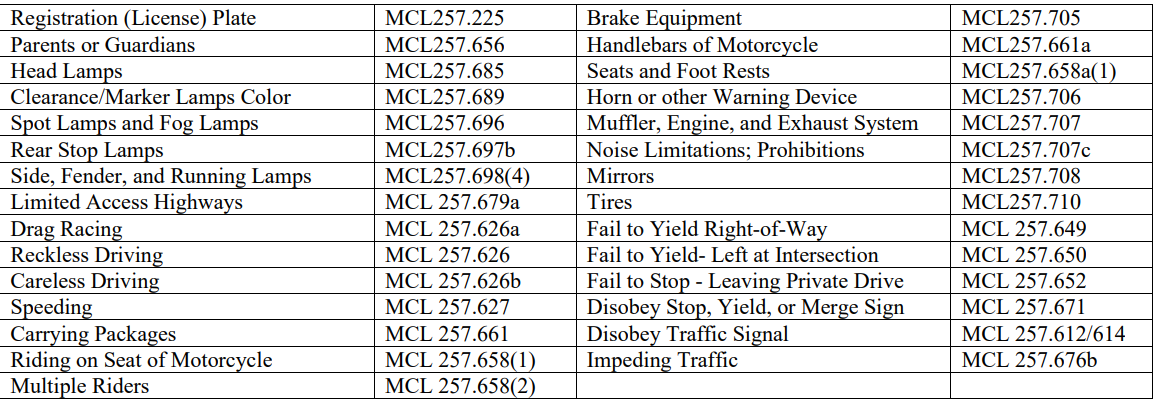
Other Equipment Laws and General Rules of the Road:
The Michigan Vehicle Code can be found in its entirety at www.legislature.mi.gov